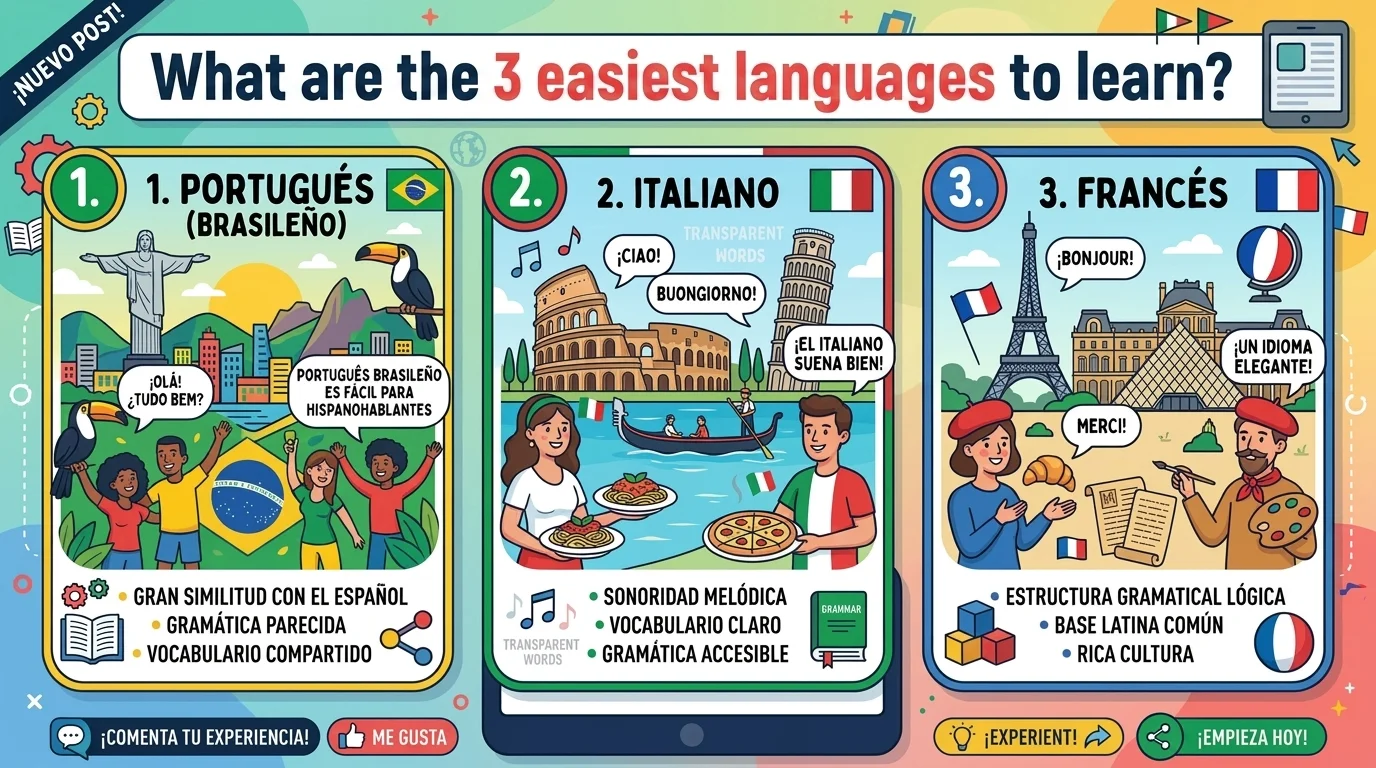
#1: Portuguese (Category I: 600 - 750 Hours)
Portuguese stands out as one of the most accessible and rewarding foreign languages for English speakers. English contains thousands of words borrowed from Latin through French history (the Norman conquest of 1066). Almost all sophisticated abstract nouns in English have direct Portuguese cognates:
- -tion words become -ção: nation → nação, celebration → celebração, communication → comunicação.
- -ty words become -dade: city → cidade, university → universidade, reality → realidade.
- -ly adverbs become -mente: naturally → naturalmente, directly → diretamente.
Furthermore, spoken Brazilian Portuguese relies heavily on progressive gerunds ("estou fazendo") which feel remarkably natural to English speakers ("I am doing"), avoiding rigid European grammatical constraints.
#2: Spanish (Category I: 600 - 750 Hours)
Spanish shares the same Category I status as Portuguese. Its primary advantage is shallow phonetic spelling: words are pronounced almost exactly as they are written with just five pure vowels.
Because Spanish and Portuguese share an astounding 89% lexical similarity, learning either one gives you immediate passive understanding of the other, essentially offering a two-for-one benefit in global communication.
#3: Dutch or Italian (Category I: 600 Hours)
In terms of Germanic grammatical roots and everyday vocabulary, Dutch sits genealogically closest to English (sharing foundational vocabulary like "water", "apple/appel", "house/huis").
Alternatively, Italian shares the melodic romance beauty and straightforward vowel clarity of the Mediterranean, though it offers less global commercial utility compared to Portuguese or Spanish in international markets.
Why Choose Portuguese Over Other Languages?
While French presents difficult silent consonants and German demands intricate case declensions (der, die, das, den, dem), Brazilian Portuguese delivers the fastest path to spontaneous, joyful conversation.
Brazil represents the largest economy in South America and ranks among the top global producers of culture, agriculture, technology, and energy, making Portuguese a formidable asset for career differentiation.
Frequently Asked Questions
What are the 3 easiest languages to learn for native English speakers?
According to the Foreign Service Institute (FSI), Portuguese, Spanish, and Dutch or Italian consistently rank as the fastest and easiest languages for English speakers to master.
Why is Portuguese easier to learn than German or French?
Portuguese has simpler regularized noun genders, phonetic spelling consistency compared to French, and none of the complex case declensions found in German.
How long does it take an English speaker to learn Portuguese?
The FSI categorizes Portuguese as a Category I language requiring approximately 600 to 750 classroom hours to reach professional fluency.
Does Portuguese share cognates with English?
Yes, thousands of Latin-root academic, legal, scientific, and technical terms in English translate almost identically into Portuguese (-tion becomes -ção).
Start speaking Brazilian Portuguese today
At Clases Portugués, we guide you step by step with clear audio lessons, practical quizzes, and no confusing academic fluff.
🎁 Try the Free Mini Course