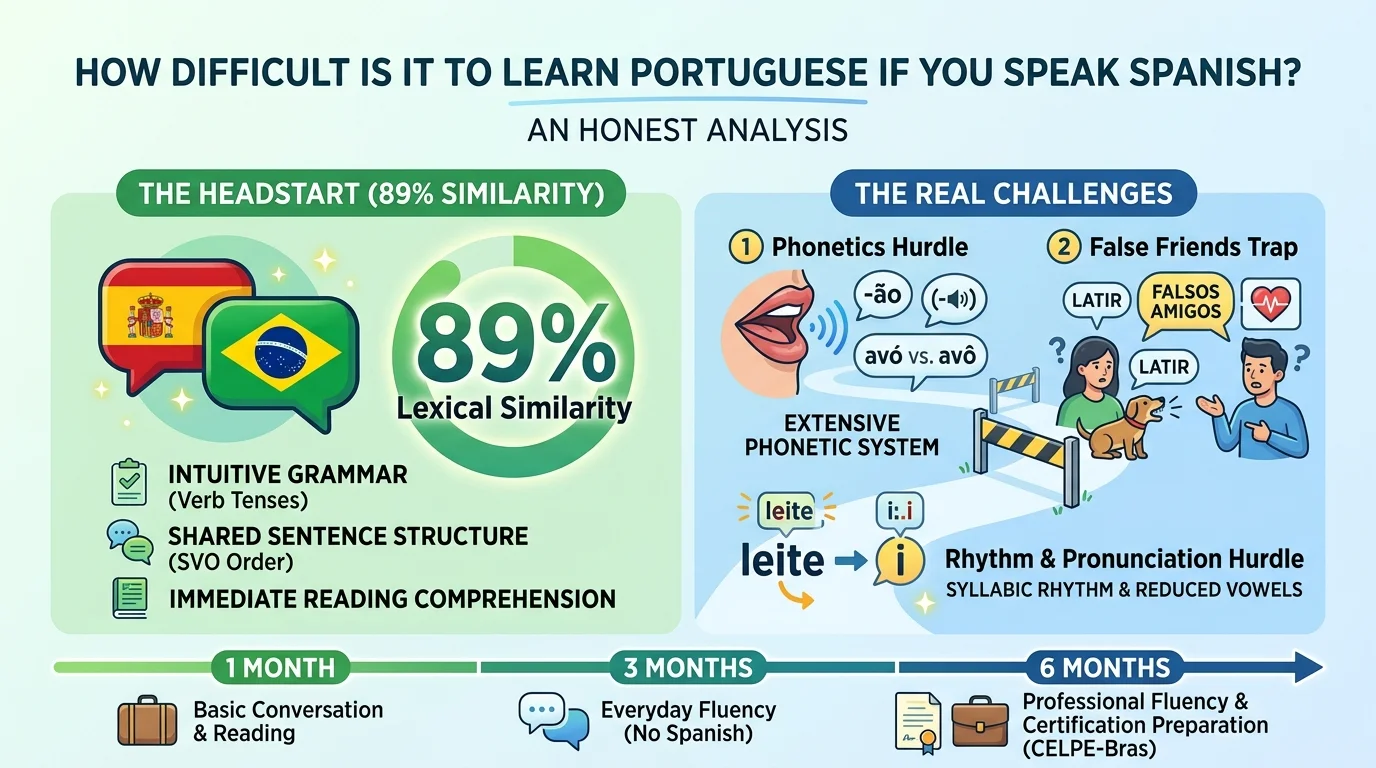
The Massive Advantage: 89% Lexical Proximity
Spanish and Portuguese developed alongside each other on the Iberian Peninsula. For someone who understands Spanish:
- Grammar is transparent: past imperfect, compound tenses, and subjunctive moods share nearly identical functional logic.
- Word roots are familiar: roughly 9 out of 10 vocabulary words share identifiable Latin origins ("desenvolvimento" corresponds directly to "desarrollo").
- Instant reading comprehension: on day one, an educated Spanish speaker can read a Brazilian news publication and comprehend 75% to 85% of the content.
The Real Obstacles: Where Spanish Speakers Stumble
The difficulty of Portuguese lies not in comprehension, but in accurate production:
- Vast vowel inventory: Spanish operates with 5 clear, unyielding vowel sounds. Brazilian Portuguese utilizes over 14 distinct vowel phonemes, including nasal vowels (-ão, -ãe, -ões) and open vs closed vowels (avó = grandmother vs avô = grandfather).
- Vowel reduction in unstressed positions: unstressed final "-e" turns into an "ee" sound and final "-o" softens into "oo." Pronouncing them as crisp Spanish vowels immediately marks an unnatural accent.
- Deceptive false friends: words that sound identical but mean the opposite. "Latir" means a dog barking, not a heartbeat; "borracha" means rubber/eraser, not an intoxicated person; "acordar" means waking up in the morning, not reaching an agreement.
How Fast Can a Spanish Speaker Become Fluent?
With a tailored comparative method that targets phonetic differences:
- 1 month: full listening comprehension and functional travel interactions.
- 3 months: spontaneous, confident conversations on professional and personal topics without resorting to Spanish crutches.
- 6 months: near-native pronunciation and full readiness for the official CELPE-Bras certification exam.
The Right Method: Contrastive Linguistics
The methodology developed by Prof. Nilton Viturino focuses explicitly on contrastive linguistics: skipping what Spanish speakers intuitively know and focusing 100% of the energy on phonetic refinement and everyday colloquial Brazilian syntax.
Frequently Asked Questions
Is Portuguese easy to learn if you already speak Spanish?
Yes, Spanish speakers have the greatest linguistic head start in the world, sharing an 89% lexical similarity and nearly identical grammatical architecture.
What is the hardest part of learning Portuguese for Spanish speakers?
Phonetics is by far the biggest challenge. Portuguese has more than 14 vowel sounds compared to Spanish's strict 5 vowels, along with complex nasal diphthongs.
What is the danger of 'portuñol'?
Portuñol gives learners a false sense of fluency where they believe they are speaking Portuguese simply by adding Brazilian intonation to Spanish words, leading to miscommunication.
How long does it take a bilingual English-Spanish speaker to master Portuguese?
A student who already commands Spanish can achieve working conversational proficiency (B1/B2) in as little as 3 to 4 months of structured practice.
Speak authentic Brazilian Portuguese, not portuñol
Join Clases Portugués and discover our proven step-by-step system with native audio clips, exercises, and immediate pronunciation feedback.
🎁 Try the Free Mini Course